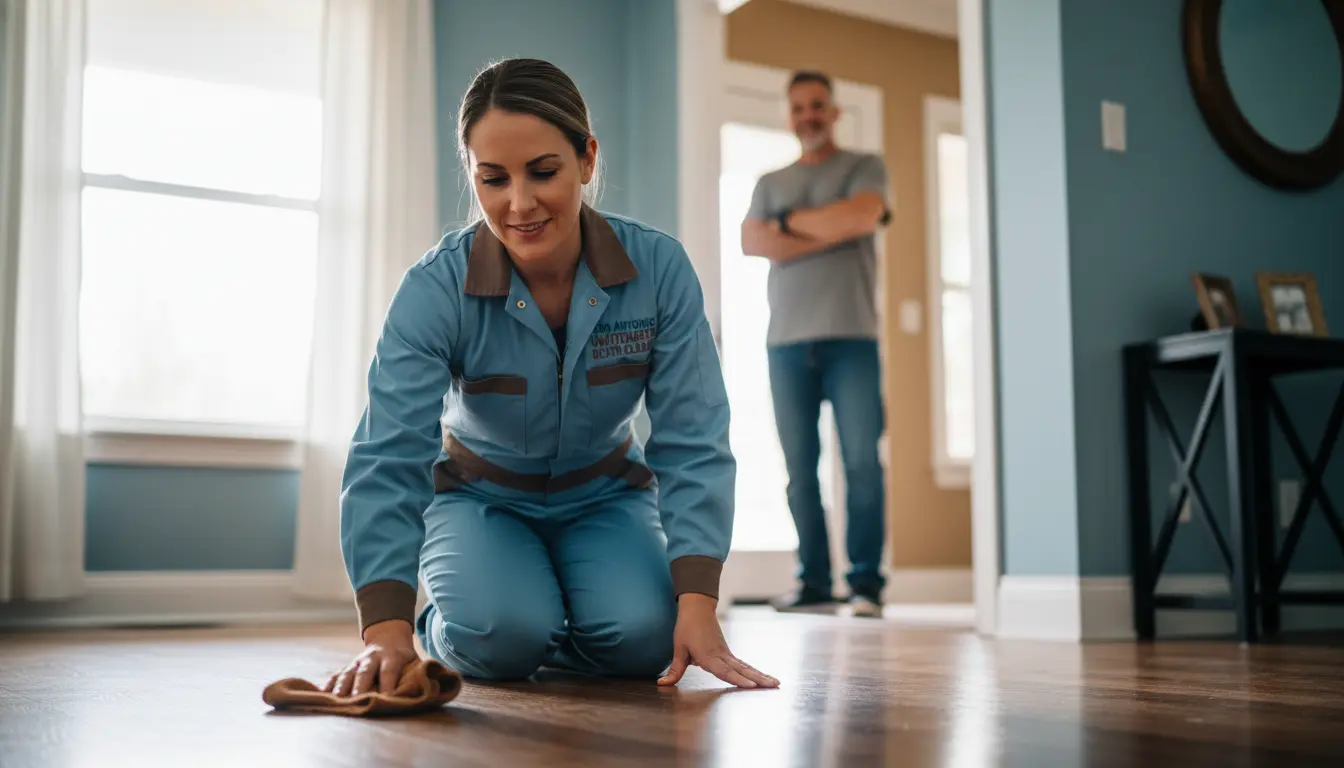
Detective Maria Rivas of the San Antonio Police Department stood in the doorway of a small bungalow on the near east side, the air thick with a smell she had learned to recognize over two decades. The tenant had not been seen in nearly three weeks, and the summer heat index in the I-35 corridor that July had pushed past 105 degrees. She already knew what the coroner would confirm: the body had been decomposing for at least ten days, and the biological fluids had seeped through the carpet into the plywood subfloor below. The home was a rental property owned by a retired couple, and the structural damage was already extensive. This is the moment when most property owners realize that standard cleaning crews are not equipped to handle the reality of an unattended death scene. The question is not whether to clean it, but who can be trusted to restore the property safely and thoroughly.
Unattended death cleanup in San Antonio presents unique challenges that go far beyond what a typical janitorial service can address. The combination of high humidity, rapid microbial growth, and the porous nature of older building materials common in the city’s historic neighborhoods means that biological contamination can spread invisibly. Without proper containment and remediation, the property becomes a health hazard for anyone who enters, including family members, future tenants, and even the restoration crew itself. Professional biohazard cleanup is not a luxury; it is a medical and legal necessity that protects both the living and the property’s long-term value.
The Hidden Dangers of Unattended Death: Why Standard Cleaning Fails
When a person dies and is not discovered for days or weeks, the body begins to decompose almost immediately. This process releases a mixture of bloodborne pathogens, bacteria, and organic compounds that can penetrate deep into flooring, drywall, and HVAC systems. The pathogens involved—including hepatitis B and C, HIV, and methicillin-resistant staphylococcus aureus (MRSA)—can survive on surfaces for days or weeks, depending on the environment. In San Antonio’s subtropical climate, with average summer temperatures hovering near 100 degrees, decomposition accelerates dramatically. Fluids from the body can migrate through carpet padding and into the subfloor, creating a reservoir of infectious material that will never be fully removed by surface cleaning alone.
Standard residential cleaning services are not trained to recognize the extent of contamination. They lack the specialized equipment, such as industrial-grade negative air machines and EPA-registered hospital-grade disinfectants, that are required to contain and eliminate biohazards. More importantly, they are not permitted by law to transport or dispose of biohazardous waste. This waste must be handled by a licensed medical waste disposal company, and the documentation must meet strict regulatory standards. Attempting to clean an unattended death scene with household bleach or over-the-counter disinfectants is not only ineffective but dangerous. Bleach, for example, loses its disinfecting power quickly in the presence of organic matter, and it can actually cause pathogens to aerosolize, increasing the risk of inhalation.
Step-by-Step Professional Remediation Process
Professional biohazard remediation follows a rigorous, science-based protocol designed to eliminate all traces of biological contamination and restore the property to a safe, habitable condition. The process begins with a comprehensive risk assessment, during which the technician identifies all affected areas, including hidden spaces such as crawl spaces, wall cavities, and ductwork. This assessment determines the scope of work and the specific safety measures required, including the level of personal protective equipment (PPE) needed. In San Antonio, where many older homes have plaster walls and hardwood floors, the assessment must also consider the risk of cross-contamination through porous surfaces.
Once the initial assessment is complete, the team establishes containment zones using heavy-duty plastic sheeting and negative air machines. These machines create a vacuum that pulls contaminated air out of the work area and filters it through HEPA filters before releasing it outside. This prevents airborne pathogens from spreading to unaffected parts of the building. Next, the physical removal of biohazardous materials begins. All visible blood, tissue, and bodily fluids are carefully collected using absorbent pads and disposed of in red biohazard bags. Carpets, padding, and any porous materials that have been saturated are cut out and removed. In many cases, subflooring and sections of drywall must also be removed to ensure that no biological material remains.
Why Local Conditions Require Specialized Techniques
San Antonio’s climate is a major factor in the speed and severity of decomposition. The high ambient heat and humidity accelerate the growth of bacteria and mold, which can spread through a property in a matter of hours. Odor molecules, which are often the first sign of a problem, can become embedded in paint, drywall, and even furniture. Professional remediation teams use enzyme treatments and ozone generators to neutralize odors at the molecular level, rather than simply masking them. The 7 essential steps for professional death cleanup help include these advanced techniques, which are specifically designed for the biological and environmental challenges found in South Texas.
Professional Remediation vs. Standard Janitorial Cleaning: A Data Comparison
The following table summarizes the key differences between professional biohazard remediation and standard residential cleaning, based on IICRC S540 standards and OSHA requirements.
| Feature/Metric | Professional Biohazard Remediation | Standard Residential Cleaning |
|---|---|---|
| Regulatory Compliance | Follows OSHA 29 CFR 1910.1030, EPA waste disposal rules, and IICRC S540 standards | No formal regulatory compliance for biohazards |
| Pathogen Elimination | Uses EPA-registered hospital-grade disinfectants, ATP testing to verify zero organic residue | Household cleaners and bleach; no verification testing |
| Structural Assessment | Identifies hidden contamination in subfloor, drywall, and HVAC; removes porous materials as needed | Surface cleaning only; does not address hidden seepage |
| Waste Disposal | Licensed medical waste transport and incineration; chain-of-custody documentation | Not permitted to handle biohazard waste; improper disposal leads to legal liability |
| Odor Removal | Enzyme treatments, ozone generators, and thermal fogging to neutralize odor at molecular level | Deodorizers and air fresheners that mask but do not remove |
| Insurance Compliance | Provides detailed documentation and ATP test results for claims | No documentation; often causes claim denial |
Expert Insights: Advanced Diagnostic Tips for Property Owners
Professional biohazard remediation specialists rely on three advanced diagnostic techniques that are rarely understood by the general public. First, the use of thermal imaging cameras to detect moisture behind walls and under floors. Even after visible fluids are removed, decomposition liquids can wick into porous materials, creating a hidden source of microbial growth. Thermal imaging reveals these areas before they become a health problem. Second, the application of ATP testing to confirm that surfaces are biologically clean. This is not a subjective test; it provides a numerical reading that is accepted by insurance adjusters and health departments. Third, the practice of negative pressure containment to prevent cross-contamination. This is especially important in multi-unit buildings, such as apartment complexes in areas like Alamo Heights or Leon Valley, where airborne pathogens could travel to neighboring units.
One of the most common mistakes property owners make is using household bleach on biological matter. Bleach is a disinfectant, but it is deactivated by the proteins in blood and tissue. It also produces toxic fumes when mixed with organic matter. Another mistake is waiting for the odor to dissipate naturally. The odor you smell is caused by gases called cadaverine and putrescine, which are produced during decomposition. These gases are not only unpleasant but also indicate the presence of airborne bacteria. Finally, allowing untrained family members or friends to enter the scene before professional remediation is a serious error. Not only does it expose them to bloodborne pathogens, but it can also disturb the evidence and complicate the cleanup process. The consequences of these mistakes include long-term health risks, structural damage that requires expensive repairs, and potential liability for spreading contamination.
Pricing: What to Expect for Professional Biohazard Remediation
Pricing for unattended death cleanup varies based on the severity of the scene, the size of the affected area, and the specific services required. While every situation is unique, most professional remediation companies in San Antonio provide transparent estimates based on the following factors:
- Site mobilization and assessment fee: This covers the initial visit, risk assessment, and containment setup. Typical fees range from $200 to $500, depending on travel distance and urgency.
- Hourly remediation rates: Most companies charge $150 to $300 per hour per technician. A standard cleanup may take four to eight hours, but more complex scenes can take multiple days.
- Disposal of biohazardous waste: Licensed medical waste disposal is an additional cost, usually between $50 and $150 per container, depending on volume and weight.
- Structural material replacement: If subflooring, drywall, or insulation must be removed and replaced, these costs are typically quoted separately. This can add $1,000 to $5,000 or more, depending on the extent of damage.
- HVAC decontamination: If the HVAC system has been contaminated, specialized cleaning and duct sealing may be required, adding $500 to $2,000.
Safety Standards and Certifications
Professional biohazard remediation companies must adhere to a strict set of safety standards and certifications to operate legally and effectively. The most important is OSHA’s Bloodborne Pathogens Standard (29 CFR 1910.1030), which requires employers to protect workers from exposure to infectious materials. This includes providing proper PPE, training, and vaccination for hepatitis B. Additionally, the IICRC S540 standard sets the industry benchmark for trauma and crime scene cleanup. Certification from the IICRC demonstrates that a company has undergone rigorous training and testing in the latest remediation techniques.
For property owners, working with a certified company means that every step of the process is documented, from the initial assessment to the final ATP test. This documentation is crucial for insurance claims and for demonstrating due diligence in the event of a legal dispute. In Bexar County, local health departments may also require proof of proper disposal for biohazardous waste. A reputable company will provide a chain-of-custody manifest for all waste removed from the site, ensuring compliance with state and federal regulations. The risks of ignoring unattended death cleanup fast are clear: without proper remediation, the property becomes a liability that can never be fully resolved.
Frequently Asked Questions About Unattended Death Remediation
How long does the professional remediation process take?
Most standard unattended death cleanups can be completed within four to eight hours, but the timeline depends on the extent of the contamination. If the body has been undiscovered for several weeks, the biological fluids may have migrated through multiple layers of flooring and into the walls. In such cases, the process may require multiple days, including the removal and replacement of structural materials. The team will provide a time estimate during the initial assessment, and they work efficiently to minimize disruption to the property.
Is it safe to live in the property after professional cleanup?
Yes, after professional remediation, the property is safe for habitation. The process includes verification testing to ensure that all biological contaminants have been eliminated. ATP testing provides a scientific measurement of cleanliness, and the final report confirms that the area meets industry standards. However, any structural materials that were removed must be replaced by a contractor, which may take additional time. The property is not safe to occupy until all repairs are complete.
Will my homeowner’s insurance cover the cost of cleanup?
Most standard homeowner’s insurance policies cover unattended death cleanup as part of the dwelling coverage, provided the policy includes provisions for removal of biohazardous materials. It is important to contact your insurance adjuster as soon as possible and to document the scene (with photos, if safe) to support your claim. Professional remediation companies can provide detailed invoices and test results that help accelerate the claims process. Always check with your provider for specific coverage details.
What should I do immediately after discovering an unattended death?
Do not enter the area. Call 911 first to report the death, and then contact a professional biohazard remediation company. Do not attempt to clean anything yourself, and do not allow family members or friends to go inside. The scene is a crime scene until the police and coroner release it, and entering without authorization can interfere with the investigation. Once the authorities have finished, the remediation team can begin the restoration process. The What Happens After An Unattended Death In San Antonio guide provides a step-by-step overview of what to expect.
Professional Biohazard Remediation in San Antonio
When an unattended death occurs, the aftermath is not something that can be handled by a mop and a bottle of bleach. The biological hazards, the emotional weight, and the legal requirements demand a professional response. San Antonio Unattended death cleanup provides the technical expertise, compassion, and regulatory compliance needed to restore a property to a safe and livable condition. From the initial call to the final ATP test, every step is performed with the highest standards of safety and respect for the deceased and their loved ones.
If you are facing the difficult situation of an unattended death in the San Antonio area, do not attempt to handle it alone. Contact a certified biohazard remediation specialist who understands the local climate, the unique challenges of older homes, and the importance of thorough documentation. The investment in professional cleanup protects your health, your property value, and your peace of mind. For more information on selecting the right service, review the top tips for choosing death cleanup services near you and take the first step toward recovery.